European Health Insurance Card (CESD): how to get it when Segurança Social Direta refuses
With this card, in any EU country you are treated in the public health system on the same terms as locals. It is free. Below is the route we took ourselves: from the online refusal to the forms sent, with filled-in samples and signing without a printer.
Straight to the application Short version — one screenWhen it helps
You fall ill while travelling
A fever in Prague, food poisoning in Spain, a broken arm skiing in Italy: treatment at a public hospital on local terms. Often free or with a small fee.
Medicines and tests
Prescriptions from a local doctor and tests ordered in the public system — with local co-payments.
Ongoing treatment abroad
Dialysis, oxygen or chemotherapy during a trip are covered too. You just arrange it with the clinic in advance.
Pregnancy
Check-ups and childbirth during a temporary stay are covered — unless the trip is made in order to give birth.
Card or insurance: where the line is
The card opens the door to public healthcare. Everything outside that door — private clinics, rescue, getting you home — is paid by travel insurance. It is not either-or: take both when you travel.
The confusion comes from the name: it says «Insurance». But it is not a policy. The card only proves that Portuguese Segurança Social pays for your treatment — in the public system of the country you are in, under that country's rules.
- Helicopter off the slope — insurance.
- Public hospital: X-ray, cast, doctor — card, plus the local fee.
- If you are taken to a private clinic — insurance: the card does not work there.
- Flight home with a medical escort — insurance.
If your passport is not from an EU country
The card is not valid in five countries: Denmark, Iceland, Liechtenstein, Norway and Switzerland. Refugees and family members of EU citizens are the exceptions.
It works in every other EU country. For the UK and non-EU nationals we did not find a clear answer — check with Segurança Social before you travel.
Two routes
Route A — online, two minutes
Segurança Social Direta → Doença → «Obter Cartão Europeu de Seguro de Doença» → «Iniciar pedido». If it lets you through, the card arrives by post and you can stop reading here.
Route B — if the portal refuses
Seeing this sentence? It is the form refusing, not the card. That was our case: a non-EU resident in Madeira. The reason surfaced six weeks later: Segurança Social had our old residence permit on file. Once we sent the new one, the form opened. Eight steps follow.
Atualmente não reúne condições para solicitar o CESD por esta via
What you will need
- Access to Segurança Social Direta and a Chave Móvel Digital with the digital signature switched on, plus its PIN.
- Your NISS — the social security number on the back of your residence permit.
- Residence permit: both sides, one file up to 3 MB.
- About forty minutes and a computer: signing and uploading is easier on a big screen.
Open a request in e-Clic
Segurança Social Direta → Contactos → «Canal e-Clic» → «Registar pedido». Topic: Cartão Europeu de Seguro de Doença. As the reason choose «Esclarecer dúvidas sobre a minha situação». Do not pick «Apresentar um pedido»: it sends you back to the same online form that refused. The text is below — add your name and municipality.
Envolvido: o próprio (titular), [NOME COMPLETO], trabalhador independente, residente em [CONCELHO], com NISS ativo.
Assunto: Cartão Europeu de Seguro de Doença (CESD).
Pedido: ao tentar pedir o CESD na Segurança Social Direta, surge a mensagem «Atualmente não reúne condições para solicitar o CESD por esta via». Não tenho nenhum cartão emitido anteriormente. Solicito que me informem o motivo e procedam à emissão do CESD em meu nome, ou me indiquem como devo fazer o pedido e que documentos são necessários.
Junto, desde já, o Modelo GIT-53 e o Modelo MG2 preenchidos e assinados, e a cópia do título de residência.
Obrigado.
Not self-employed? Change «trabalhador independente». Keep the last sentence only if you attach the forms right away.
Confirmed: sending everything at once saves three and a half weeks. Tested on the second applicant: GIT-53, MG2 and the permit attached to the very first request — card in 14 days. The first one, with a request for information in between, took 39.
Wait for the reply
We got an answer after 18 days: send form GIT-53, form MG2 and a copy of the residence permit. The request became «Pendente de Informação», with 30 days to reply — otherwise it is closed. The blank forms are attached to the request itself, «Documentos» tab, and on the Segurança Social website.
Forms on the Segurança Social websiteFill in GIT-53 — the card application
Four pages; you fill in the first and the third. Below is a sample with made-up data; the numbers in the picture are explained underneath.
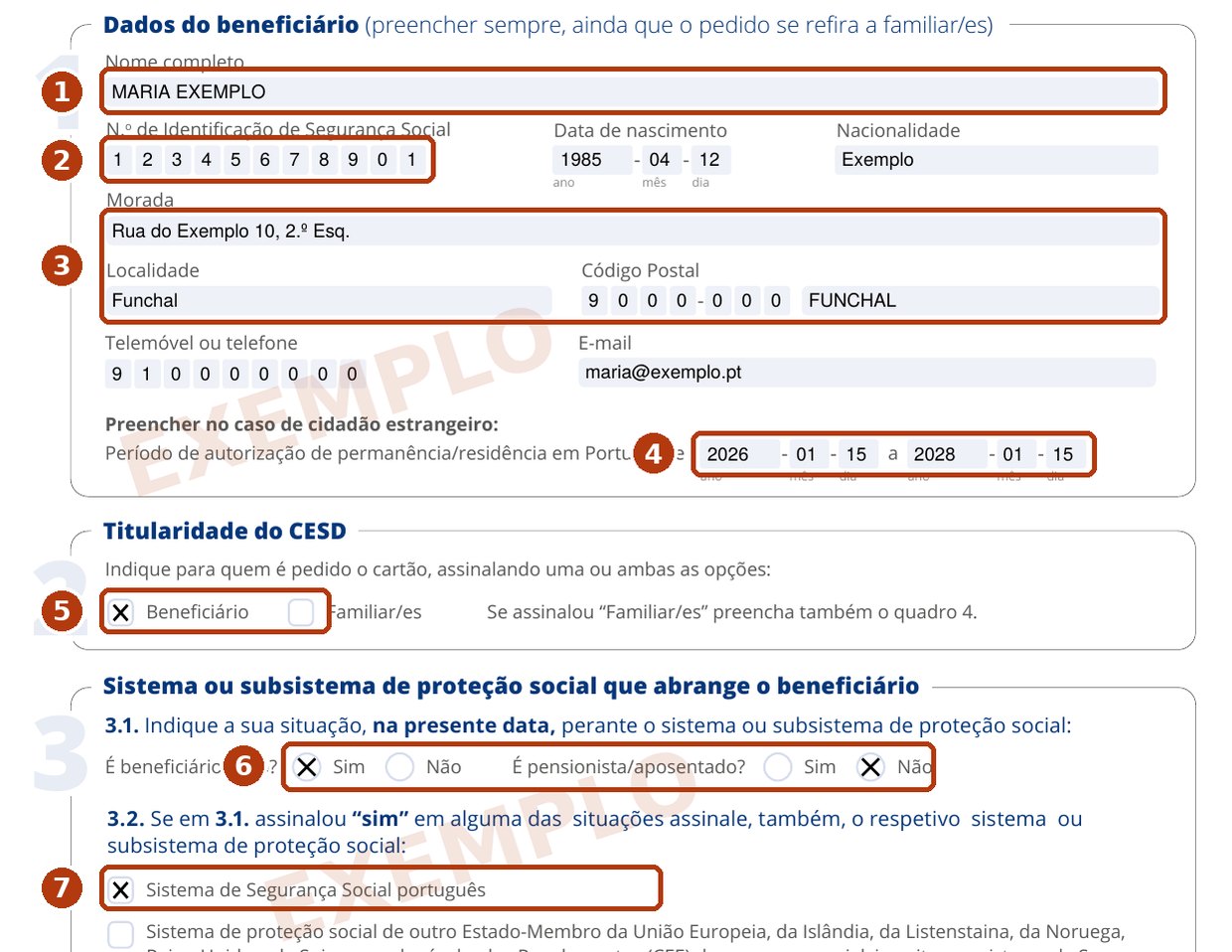
- Name — as on your residence permit.
- NISS — eleven digits.
- Address — as on your residence permit. We copied it from the card word for word.
- «Período de autorização de residência»: the permit's issue date and expiry date. Issue date is on the back, expiry on the front.
- Box 2: «Beneficiário» — the card is for you. Dependent family members go in box 4 on page 2; each gets their own card.
- 3.1: employed or self-employed — «Sim» to the first question, «Não» to the second. The other way round for pensioners.
- 3.2: «Sistema de Segurança Social português». Leave section 3.3 empty.
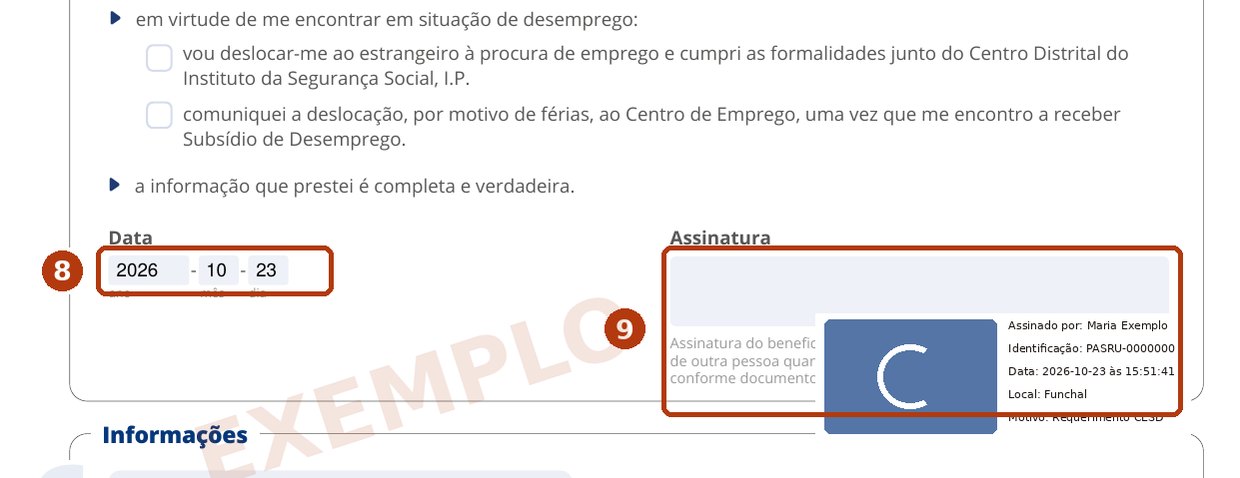
- Page 3: today's date.
- The signature goes here: by hand or digitally, as in step 5. The CMD stamp lands just below the field — that is fine, it does not cover the declaration text.
Fill in MG2 — update of personal data
The «Alteração de dados» form, one page. Segurança Social asks for it with the permit copy — as we understand it, to check your details and the address the card is posted to.
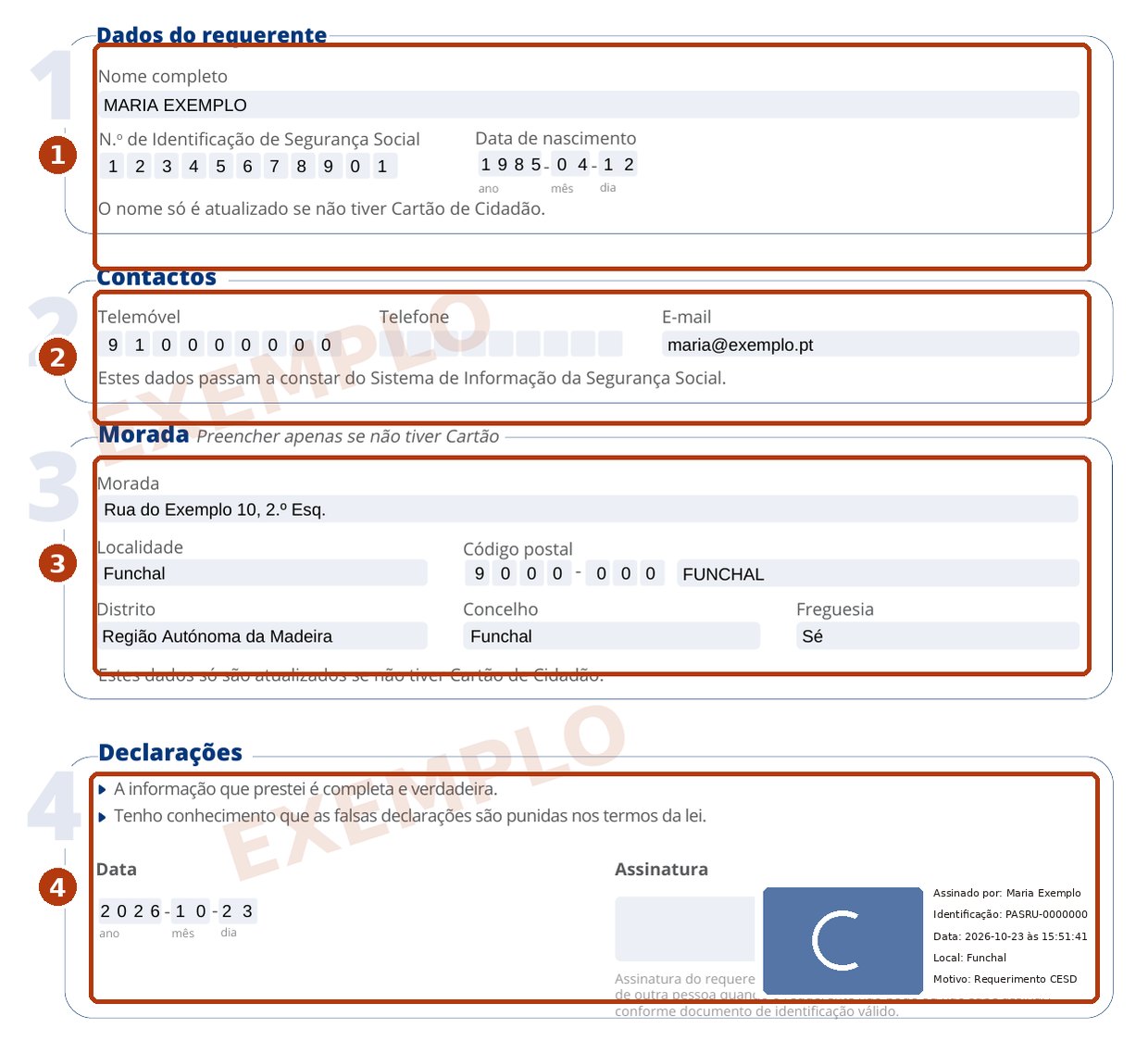
- Name, NISS, date of birth.
- Mobile and e-mail. They go into the Segurança Social records.
- The address is filled in by anyone without a Cartão de Cidadão — that is, foreigners. As on your residence permit.
- Today's date; the signature in the field on the right.
Sign without a printer — Chave Móvel Digital
A free government service: cmd.autenticacao.gov.pt → «Assinatura de Documentos». You need the CMD signature switched on and its PIN. Files up to 3 MB. Sign each form separately.
- Upload the original, unsigned PDF. Upload one that is already signed and it ends up with two signatures.
- Tick «Deseja que a assinatura esteja visível no documento?» — the signature must show on the page.
- Orientation: Vertical. In «Motivo» avoid long dashes and quotes: special characters turn into «???». «Local»: your town.
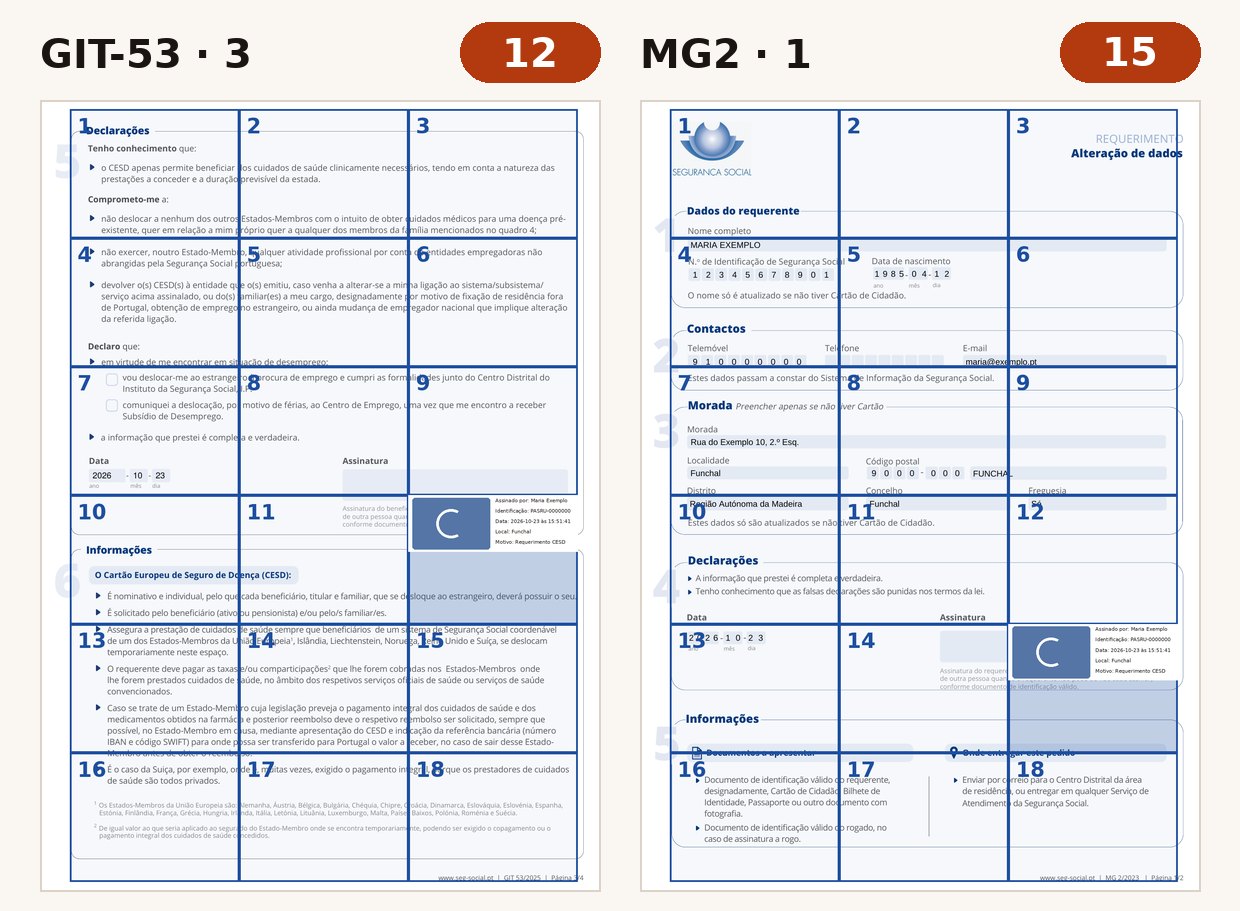
- Page and position 1–18 — the least obvious part. The stamp lands in the upper part of the chosen cell; we missed twice. Correct: GIT-53 — page 3, position 12; MG2 — page 1, position 15.
- Phone number, signature PIN, SMS code — then download the signed file.
Copy your residence permit
Both sides on one page, file up to 3 MB. With a phone: the card on a dark plain table, daylight, no flash, phone parallel to the card, tap to focus on the line with the numbers. Flash glares on the hologram and the NIF and NISS become unreadable.
Send the reply
Open the request → «Responder ao pedido». Paste the text below, then «Adicionar documento» — one file at a time: GIT-53, MG2, permit. Then «Enviar resposta»; the status changes to «Em Análise». The Segurança Social session is short: have the files ready first — ours expired halfway.
Exmos. Senhores,

Na sequência do pedido de informação, junto os documentos solicitados para a emissão do Cartão Europeu de Seguro de Doença (CESD):

1. Modelo GIT-53, devidamente preenchido e assinado;
2. Modelo MG2, devidamente preenchido e assinado;
3. Cópia do título de residência (frente e verso).

Fico ao dispor para qualquer esclarecimento adicional.

Com os melhores cumprimentos,
[NOME COMPLETO]
NISS [NÚMERO]
Wait for the card
According to Segurança Social, the card arrives by post 5–7 working days after it is issued, at the address on file. Travelling sooner? The Provisional Replacement Certificate (CPS) has the same legal value. No need to ask anyone: as soon as the card is issued, Segurança Social Direta → CESD → «Ações» → «Obter certificado provisório» — the PDF downloads instantly. Ours came with the card's full validity.
Our case, by date
- 26.09.2026The online form refused. Request sent through e-Clic.
- 14.10.2026Reply: GIT-53, MG2 and a permit copy, by 13 Nov.
- 23.10.2026Forms signed with CMD and sent. Status: «Em Análise».
- 04.11.2026First card issued. 39 days from the refusal, 12 from sending the forms. CPS downloaded the same evening.
- 06.11.2026Second application (everything at once, 23 Oct): Segurança Social replied «permit updated, you can apply online» — the form let us through, card in two minutes. 14 days. CPS right away.
- …The plastic cards are in the post. We will add a line when they arrive.
In short
How much does the card cost?
Nothing. Websites charging for «processing» are middlemen: only Segurança Social issues the card.
I have the card. Do I still need travel insurance?
Yes. The card covers public healthcare only. Private clinics, rescue and getting home are for insurance — take both.
Why is it called «insurance» if it is not insurance?
The name is European: European Health Insurance Card, in Portuguese Cartão Europeu de Seguro de Doença. But there is no policy behind it: the card proves you are covered by the Portuguese public system, which pays for your treatment in another country's public system.
The ambulance took me to a private clinic. What now?
Say you have the EHIC and ask to be transferred or referred to a public hospital. The card does not pay a private clinic — only insurance or you do. To avoid this, check before you travel where the nearest public hospitals are: Segurança Social itself advises it.
I paid myself because I did not have the card with me. Will I get it back?
Keep every invoice and hand them in at your health centre in Portugal when you are back. Whether and when you are refunded is decided by the Ministry of Health. So get the card before you travel — and if there is no time, the Provisional Replacement Certificate (CPS).
Do my spouse and children need their own card?
Yes, one each. Dependent family members can be listed in box 4 of the same GIT-53.
Can I do it without Chave Móvel Digital?
Yes: print the forms, sign by hand and scan — or hand them in at a Segurança Social office. In Madeira that is ISSM.
How long is the card valid?
Three years, but never beyond your residence permit: in our case the card's expiry matched the permit's. Renew in the last 30 days, online or in person.
A question, your experience or an idea?
If something went wrong, Segurança Social answered differently or you found a shorter route — write to me. I answer myself, and your case (without personal data) goes on this page to make it easier for the next person.
More on nDm
Madeira resident card
Trails for 0 € and the Porto Santo subsidy. The SIMplifica application screen by screen.Flight subsidy
How to get part of your Madeira — mainland ticket back. Five portal screens.If you run a business
Madeira grants and support programmes for companies — a separate checker.Who wrote this
Igor Kartuzov, SeedWave. I went through this between September and November 2026, together with my wife. The sample forms carry made-up data; the signature positions, timings and wording come from our applications. If yours went differently, message me on LinkedIn and I will update the page.
Sources
- Guia Prático — Cartão Europeu de Seguro de Doença · Instituto da Segurança Social, N39 v4.23, 24.01.2025
- Your Europe — Unplanned healthcare, temporary stays · Comissão Europeia
- Segurança Social — Formulários · Modelo GIT 53, Modelo MG 2
- autenticacao.gov.pt — Assinatura de documentos com a Chave Móvel Digital
- Regulamento (UE) n.º 1231/2010 — nacionais de países terceiros
- Linha Segurança Social: 210 545 400 · 300 502 502 (dias úteis, 9h–18h)